
See the enterprise differently.
DOS helps leaders see how the enterprise actually operates, remove what prevents execution, align the organization around enterprise value, and build the capability to improve continuously.
The executive operating system for a connected enterprise
Douglas Operating System (DOS) is an integrated executive operating system designed to help leaders see, govern, and improve the enterprise as one connected system. Through its 10 Laws, 91 Operating Principles, and integrated enterprise frameworks, DOS connects leadership behavior to governance, accountability, cross-functional performance, customer value, resilience, and transformation. Unlike approaches focused primarily on individual functions, projects, or improvement methods, DOS is designed to provide a unified executive operating architecture that works alongside an organization's existing systems and methodologies.
DOS is developing a particularly integrated, repeatable system of executive governance that makes interdepartmental performance a first-class management responsibility.
Choose your DOS path →How DOS works alongside your tools →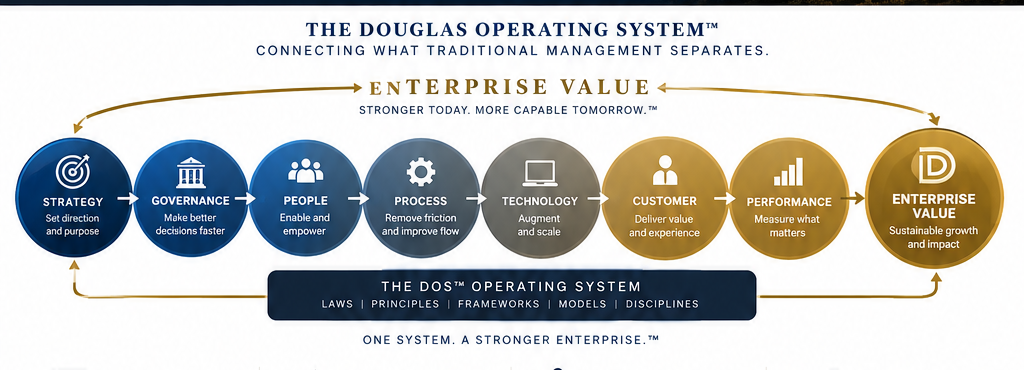
An executive operating system—not another isolated management framework.
The Douglas Operating System (DOS) creates enterprise value by giving leadership a coherent management architecture for seeing, governing, and improving the company as one integrated system rather than as a collection of independently optimized functions. Its Laws establish the leadership logic; its 91 controlled Operating Principles translate that logic into repeatable executive behaviors, decision standards, and management disciplines; and its frameworks operationalize the methodology across operating architecture, governance, performance, customer experience, resilience, customer value, leadership accountability, enterprise value creation, and responsible AI. Together, these elements expose hidden cross-functional dependencies, reduce friction and rework, prevent local optimization from damaging enterprise performance, improve the quality and speed of governance, develop organizational capability before raising expectations, strengthen the customer and employee experience, make performance evidence more actionable, and turn transformation from a periodic initiative into an institutional capability. In practical terms, DOS helps an organization see what is actually happening, understand why it is happening, decide where leadership intervention will create the greatest value, align functions around shared outcomes, and build an enterprise that can execute, learn, adapt, and improve more consistently over time.
10 DOS Laws
The enduring leadership logic that governs how leaders see the enterprise, remove barriers, build capability, govern execution, integrate functions, and sustain transformation.
Explore the DOS Laws →91 Operating Principles
Controlled principles that translate the Laws into observable executive behaviors across enterprise systems, leadership, transformation, risk, culture, governance, and future capability.
Explore the Knowledge Library →Executive Frameworks
Practical operating mechanisms that turn DOS logic into decisions, governance, customer outcomes, performance systems, resilience, accountability, and enterprise value.
Explore the Frameworks →The ten DOS Laws work together as one enterprise leadership philosophy.
They are not slogans. They establish the conditions DOS expects leaders to create before judging performance, optimizing functions, or declaring transformation complete.
Frameworks turn DOS leadership logic into operating mechanisms.
Each framework addresses a different enterprise management requirement. Their value increases when they operate together as one architecture rather than as separate initiatives.
EOA™Enterprise Operating Architecture™
Aligns the enterprise operating design—structure, accountability, capabilities, decisions, and workflows—to what strategy actually requires.
EGM™Executive Governance Model™
Clarifies decision rights, ownership, escalation, evidence, and executive forums so governance improves decision quality and execution speed.
EPF™Enterprise Performance Framework™
Matures measurement from activity reporting toward diagnosis, prediction, prescription, action, and demonstrable enterprise value.
ECXF™Enterprise Customer Experience Framework™
Connects customer outcomes to the cross-functional journeys, handoffs, processes, technologies, and dependencies that actually create the experience.
ERF™Enterprise Resilience Framework™
Integrates risk, reliability, continuity, readiness, and resilience into enterprise design rather than treating them as isolated controls.
CVM™Customer Value Model™
Clarifies how operating decisions create—or destroy—customer, economic, workforce, strategic, and stakeholder value.
LAS™Leadership Accountability System™
Connects expectations with clarity, authority, capability, coaching, evidence, and fair accountability so people can succeed consistently.
EVL™ · MODELEnterprise Value Loop™
Links operating decisions, execution, evidence, learning, and adaptation back to measurable enterprise outcomes and value realization.
EOM™ · MODELExecutive Operating Model™
Defines how executive priorities, decision rights, governance rhythms, accountability, measures, and operating commitments work together in practice.
RAI · DISCIPLINEResponsible AI Governance
Ensures AI strengthens judgment, accountability, capability, and enterprise value rather than automating existing dysfunction or diluting ownership.
The organization becomes easier to see, govern, execute, and improve.
The aim is not framework adoption. The aim is a stronger enterprise operating capability that produces better decisions and better outcomes.
Leaders see causes, constraints, dependencies, and consequences across functions instead of managing from fragmented reports.
Recurring barriers, handoff failures, duplicated effort, unnecessary approvals, and workarounds become visible and removable.
Governance clarifies authority, evidence, ownership, escalation, execution, and verification rather than adding administrative delay.
Expectations rise with the tools, skills, authority, capacity, data, coaching, and cross-functional support required to sustain them.
The enterprise manages complete journeys and operating conditions, reducing the effort and failure transferred across boundaries.
Change becomes a repeatable capability supported by evidence, readiness, learning, scaling, institutionalization, and renewal.
Do not ask only whether your departments are performing. Ask whether your enterprise is operating as a system.
DOS gives executives a disciplined way to connect what traditional management structures separate—and to turn better operating conditions into measurable enterprise value.
Ready to move from understanding to action?
Choose the right DOS starting point based on the operating problem you are trying to solve.